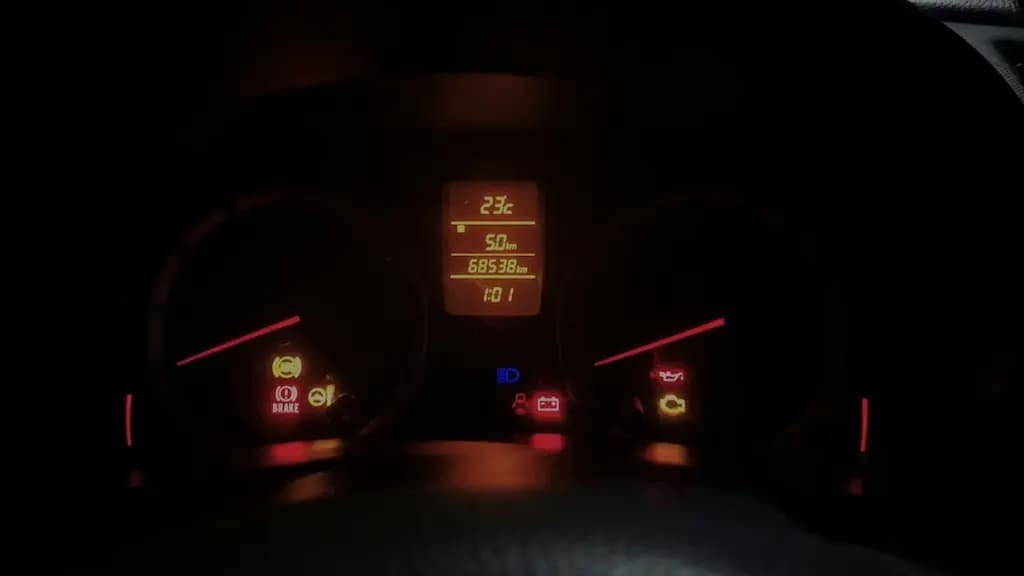
The check engine light (CEL) remains one of the most common—and misunderstood—yellow dashboard warnings. Because it covers engine management, ignition, air–fuel mixture control, and emissions systems, its meaning ranges from minor to urgent. This guide breaks down why the CEL appears, how serious it may be, how it affects U.S. inspections, and what to do next without offering repair steps. A fuller overview of dashboard symbols is available in our dashboard warning lights guide.
Quick Summary
- The CEL warns that the engine or emissions system detected a fault via OBD-II monitoring.
- Steady light: non-urgent fault. Flashing light: severe misfire likely harming the catalytic converter.
- Top causes: loose gas cap, O2 sensor failure, MAF sensor issues, misfires, EVAP leaks.
- Severity varies: minor issues may allow normal driving; critical ones require stopping immediately.
- U.S. inspections: any active CEL generally means an automatic fail.
What the check engine light actually means
Modern vehicles use an engine control module (ECM) to regulate combustion, ignition timing, fuel delivery, and emissions. When a monitored parameter falls outside acceptable limits, the ECM stores a diagnostic trouble code (DTC) and turns on the CEL. Because it covers such a wide range of systems, the same light can indicate anything from an EVAP leak to a misfire that overheats the catalytic converter.
How modern OBD-II diagnostics work
OBD-II continuously checks sensor data such as O2 content, airflow, manifold pressure, crankshaft and camshaft timing, and catalyst efficiency. Some faults trigger the light immediately, while others require repeated failures across multiple drive cycles. This is why a CEL may appear a day or two after symptoms begin—or remain even after the car seems to drive normally.
Steady vs. flashing check engine light (quick distinction)
A steady CEL signals a fault that affects emissions or performance but usually does not require emergency action. A flashing CEL warns of severe misfires that can quickly damage the catalytic converter. For expanded safety guidance, see our dedicated article on the flashing check engine light.
Most common causes of a check engine light
Emissions-related causes (O2 sensor, catalytic converter, EVAP leaks)
- O2 sensor failure: A top culprit. Inaccurate readings lead to rich/lean operation and reduced fuel economy.
- Catalytic converter efficiency issues: Often connected to long-term misfires or a rich mixture.
- EVAP leaks: Cracked hoses, vent valve issues, or a faulty purge valve allow vapor loss.
Air and fuel measurement issues (MAF sensor, MAP sensor, vacuum leaks)
- MAF sensor malfunctions: Disrupted airflow readings cause hesitation and poor throttle response.
- MAP sensor faults: Incorrect intake pressure data affects engine load calculations.
- Vacuum leaks: Unmetered air creates lean conditions and can trigger misfire codes.
Ignition-related causes (spark plugs, coils, misfires)
- Worn spark plugs: Lead to intermittent misfires, especially during acceleration.
- Failing ignition coils: Cylinder-specific misfires under load are common.
- General misfires: Caused by issues in fuel delivery, air management, or spark generation.
Fuel system problems (injectors, pressure issues)
- Dirty or sticking injectors: Result in weak combustion or rough idle.
- Fuel pump or pressure irregularities: Lower-than-expected pressure causes hesitation and lean conditions.
Electrical or ECU-related faults
Electrical problems—including wiring faults, low battery voltage, or ECM communication issues—can cause intermittent CEL activation. Faults in crankshaft position sensors or camshaft position sensors may disrupt ignition timing, trigger misfire codes, or in extreme cases lead to no-start situations.
Loose or faulty gas cap (very common)
A loose, cracked, or missing gas cap disrupts the EVAP system and commonly triggers small-leak codes. This can occur immediately after refueling or after temperature swings.
Symptoms you may notice when the light is on
Performance changes
You may feel hesitation, rough idle, sluggish acceleration, or limited power if ignition or air–fuel measurement is affected. Misfires may feel like momentary jerks during acceleration.
Fuel economy impact
Rich mixture conditions, failing sensors, or misfires typically reduce MPG because the ECM switches to protective fuel strategies.
Exhaust or smell indicators
Strong fuel smell, sulfur odors, or visible smoke may appear when combustion or emissions components malfunction. These signs usually indicate moderate-to-severe issues.
How serious is it? Understanding severity levels
CEL severity ranges widely. These categories help illustrate what drivers typically encounter and why prompt evaluation matters.
Low-urgency issues
These faults rarely affect drivability but still influence emissions and inspection readiness:
- Gas cap issues after refueling: A driver fills up, forgets to tighten the cap fully, and sees the CEL appear the next day—yet the car runs normally.
- Small EVAP leaks: Hairline cracks or loose fittings trigger pressure faults but cause no performance symptoms.
- Mild sensor drift: Slight deviations in O2 or MAF readings that do not noticeably affect the engine.
Even though the vehicle feels fine, these faults can block emissions readiness monitors from completing. This means the car may fail inspection despite driving perfectly.
Moderate issues you shouldn’t ignore
These problems often produce noticeable symptoms and can worsen with time:
- O2 sensor degradation: Causes fuel mixture corrections that reduce MPG and increase emissions.
- MAF/MAP sensor inconsistencies: Drivers may feel hesitation, surging, or a soft throttle response.
- Vacuum leaks: Often cause rough idle, light misfires, or fluctuating RPM.
- Mild fuel delivery issues: Weak injectors or low fuel pressure create lean conditions that eventually strain the catalytic converter.
If ignored, these can raise emissions significantly, accelerate catalytic converter wear, and cause the ECM to set additional fault codes. They also increase the likelihood of failing a future inspection—even if the vehicle still seems drivable.
Critical issues that may damage the engine
These conditions require immediate attention because they can cause rapid and costly damage:
- Active misfires: Unburned fuel enters the exhaust stream, overheating the catalytic converter within minutes.
- Severe fuel imbalance: Extremely rich running can melt converter internals; extremely lean operation risks overheating pistons.
- Sudden loss of power or overheating: May indicate serious ignition, timing, or fuel control failures.
If the vehicle starts shaking violently, loses ability to accelerate, or produces strong fuel smells, pull over safely and arrange a tow. For broader safety context beyond the CEL, our immediate-stop warnings cover critical red symbols.
Comparison Table
| Severity Level | Typical Causes / Examples | Common Symptoms | Can You Keep Driving? |
|---|---|---|---|
| Low | Loose gas cap, small EVAP leak, minor sensor drift | No symptoms or very mild changes | Yes, short distances; inspection impact possible |
| Moderate | O2 sensor failure, MAF/MAP issues, vacuum leaks | Reduced MPG, hesitation, rough idle | Yes, cautiously; schedule diagnosis soon |
| Critical | Active misfires, severe fuel imbalance, catalyst-threatening faults | Rough running, smoke, strong odors, flashing CEL | No; stop and arrange service |
Can you keep driving with the check engine light on?
Situations where it’s generally safe to continue
- Steady CEL with no performance changes
- No unusual smells or smoke
- Normal engine temperature
- Short-distance, low-load driving
Situations where you should stop immediately
- Flashing CEL indicating severe misfires
- Harsh running or sudden power loss
- Fuel smell, smoke, or overheating
Misfires can overheat a catalytic converter extremely quickly, sometimes in a single drive cycle.
When the light may turn off on its own
Minor faults—like a loose gas cap—may resolve themselves if the ECM detects normal operation for several drive cycles. However, the underlying code may remain stored.
Check engine light and U.S. inspections
Most states use OBD-II plug-in inspections for modern vehicles. The inspector’s tool checks stored codes and emissions “readiness monitors.” Understanding how these monitors function helps explain why a vehicle can fail inspection even with no symptoms.
How the CEL affects emissions readiness
Every emissions-related system—catalyst, O2 sensors, EVAP, EGR, fuel trim, and more—has an internal self-test the vehicle must complete. These are called readiness monitors. If several monitors remain “not ready,” the car cannot pass inspection because the state cannot confirm emissions compliance.
Scenarios that reset monitors include:
- Disconnecting or replacing the battery
- Clearing codes manually with a scan tool
- Certain intermittent faults that interrupt test sequences
Why many states will fail the vehicle if the CEL is on
An illuminated CEL—whether steady or flashing—indicates that emissions performance is not meeting standards. Under federal guidelines, states are required to fail vehicles with active emissions-related DTCs. Even if the CEL turns off temporarily, pending codes or incomplete monitors can still cause a fail. This is why resolving CEL issues weeks before an inspection is ideal.
The NHTSA also reinforces that dashboard warnings are tied to safety and regulatory compliance, emphasizing the importance of prompt evaluation.
If your dashboard shows additional inspection-related warnings, visit our guide on inspection fail lights.
What to do next (without repair instructions)
Benefits of OBD-II scanning
A scan reveals stored codes, freeze-frame data, and whether faults are pending, confirmed, or intermittent. This helps determine if the issue lies in emissions control, ignition timing, sensor communication, or fuel delivery.
When to seek professional diagnostics
Professional technicians can analyze live data, test fuel pressure, and perform smoke testing for vacuum or EVAP leaks. Seek expert help if multiple codes appear, the CEL flashes, or drivability declines.
How to prevent future check engine warnings
Fuel quality, maintenance intervals, and sensor health
- Using quality fuel reduces deposits that contaminate MAF sensors or O2 sensors.
- Following maintenance schedules keeps spark plugs, filters, and sensors operating within expected ranges.
- Addressing early symptoms prevents rich or lean operation from damaging the catalytic converter.
- Ensuring the gas cap seals properly maintains EVAP integrity.
FAQs (brief, scannable answers)
What is the most common reason the check engine light comes on?
Loose gas caps, O2 sensor issues, and EVAP leaks are among the most common triggers.
Is it safe to drive with the check engine light on?
Safe for short distances if the light is steady and performance is normal; unsafe if flashing.
Can a check engine light go off by itself?
Yes. Some minor issues resolve after several normal drive cycles.
Will a loose gas cap cause the check engine light to turn on?
Yes. It’s a frequent source of EVAP-related codes.
What does a steady check engine light mean vs. a flashing one?
A steady light is non-urgent; a flashing one indicates severe misfires.
How long can you drive with the check engine light on?
Short-term driving may be fine with a steady light, but diagnosis should not be delayed.
Can low-quality fuel trigger the check engine light?
Yes. It can cause misfires or sensor contamination.
Will the check engine light make me fail inspection?
Yes. Most states automatically fail vehicles with an active CEL.
Should I get an OBD-II scan when the check engine light turns on?
Yes. It’s the fastest way to identify the system involved.
Can cold weather or battery issues cause the check engine light?
Low voltage or extreme cold can cause temporary sensor or communication faults.
For more context on yellow dashboard indicators, see our page on yellow warning symbols.